The Weight of History: How a Brass Artifact & JRI-Poland Reconnected Two Brothers
By Mateusz Ostrowski
The quest for our roots often begins with a name on a screen. For me, it began with a DNA test and my great-great-grandfather, Szaja Reinfeld. What started as personal curiosity led to a brief but eye-opening stint as a volunteer for JRI-Poland, indexing Warsaw vital records. This small contribution unexpectedly paved the way for my own “full-circle” moment—bridging a century of separation.
The Merchant of Warsaw
Szaja was a merchant in the vibrant Jewish quarter of Warsaw until his death in 1928; today he rests in the Jewish Cemetery on Okopowa Street. Driven by a passion to understand the world he inhabited, I didn’t stop at Szaja. I began an exhaustive analysis of every Reinfeld living in Warsaw during that era. It was during this deep dive into the archives that the lines between my personal research and the collective history of the community began to blur.
The Brass Weight of History
Through my research I moved back another generation to Szaja’s father, Izaak Eliasz Reinfeld. Izaak was a brassworker. In a stroke of almost miraculous luck, I managed to track down and purchase a brass weight manufactured in his Warsaw workshop from an auction site. Holding an object created by my ancestor’s own hands was a tactile connection to the past that no document could replicate. At that point, I felt my research was nearly complete. I thought the “book” on the Reinfeld family was closed. I was wrong.
The Connection: Enter Dan Hammer
The turning point came through the collaborative spirit of the JRI-Poland community. Hadassah Lipsius, the dedicated Warsaw Area Coordinator, reached out to me. She had been contacted by a man named Dan Hammer (through the JRI-Poland.org website) who was also researching the Reinfelds of Warsaw.
Hadassah connected us, and the pieces fell into place with startling clarity. Dan’s great-grandfather, Abraham Reinfeld, was the younger brother of my Szaja. While Szaja remained in Poland, Abraham had sought a new life, emigrating to New York in 1913.
The documents I found told a story of brotherly love maintained across an ocean. In April 1918, as World War I neared its end and Warsaw struggled with hunger and epidemics, Abraham sent $25 to Szaja—a lifeline during a desperate time. Two years later, when Abraham’s daughters sailed for America, their manifest listed their contact in Poland: “Szaja Reinfeld, Twarda 24.”
A Century Later in Krakow
The culmination of this research moved from the digital realm to the physical world when Dan and his wife, Janice, traveled from the United States to Poland. We met in Krakow—two branches of a tree that had been split by the Atlantic for over 100 years.
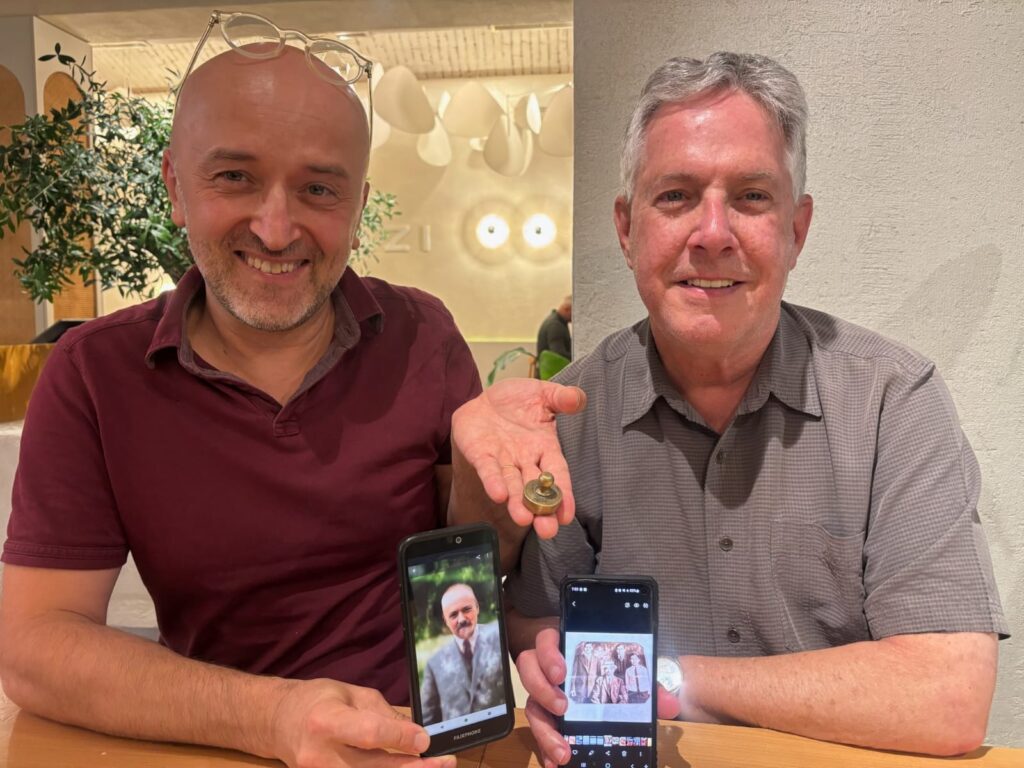
As we sat together, Dan and Janice, me and my wife Zofia, sharing stories of our modern families, we reached a moment of pure synchronicity. We both pulled out our phones to show photos of our respective great-grandfathers. Seeing Szaja and Abraham side-by-side on our screens, Janice had a beautiful idea: “Let’s take a photo of you holding their photos.” In that moment, I also held the brass weight—created by their father, Izaak—over the images. It felt as though the brothers were finally reunited through their descendants.
Returning to the Source
After our emotional meeting in Krakow, Dan and Janice continued their pilgrimage to Warsaw. The journey became even more personal as they walked the ground our ancestors once trod. They visited the Jewish Cemetery on Okopowa Street to pay their respects at Szaja’s grave—a powerful bridge between the American and Polish branches of the family.
They also visited Bagno Street in the heart of Warsaw, the site where the Reinfeld family home once stood. Standing at that address, where the daily lives of our ancestors unfolded, brought the archival records to life.
The Deeper Meaning
This connection is more than just a success story; it is a healing of the family system. For the generations that follow us, the “black hole” of the past has been filled with light and names.
My journey underscores the vital importance of the JRI-Poland database. It is far more than a collection of dates; it is a powerful engine of discovery that allows us to reclaim our heritage. By indexing these records, we aren’t just processing names—we are mending the broken threads of history. This database was the bridge that finally brought Szaja and Abraham back together through their descendants, proving that even after a century, no family is ever truly lost.
A Krakow-based psychotherapist and former journalist, the author combines his passion for deep research with amateur genealogy. While he enjoys uncovering ancestral roots, he is currently most occupied with the youngest branches of his family tree—his children.